
Macomb County Projected vs Actual Release
A projected date describes a legal or administrative point that may lead toward release. An actual date records an event that occurred. In OTIS, `EARLIEST RELEASE DATE` is normally the first parole-eligibility date, while `DATE PAROLED` records the parole event. At Macomb County Jail, a court can authorize bond before staff complete the physical release. Each source is accurate only for the event it records.
A pretrial detainee often has no computed sentence-end date. Bond terms, a dismissal, a plea, sentencing, or another court order can change custody. For a sentenced person, the calculation depends on whether the sentence is being served in the county jail or an MDOC prison. A transfer can end one agency’s custody without placing the person in the community.
Macomb’s official bond process shows why event labels matter. During court hours, most bonds go through the relevant court, subject to the Sheriff’s published exceptions. MCSO warns that an assigned unit and jail activity can make release take several hours after payment. A receipt establishes the bond transaction, while the jail release record establishes the later physical exit. Neither event predicts whether another agency will accept custody.
Find a Macomb County Release Date
Start with the last known custodian, not merely the location of the underlying case. Macomb JailTracker is a present-custody roster and does not publish a past-release archive. OTIS covers MDOC prisoners and supervision but excludes jail-only sentences. The courts supply legal orders, while the holding agency supplies the transaction that shows when its custody ended.
- Determine whether the person is held by Macomb County Jail, a municipal jail, MDOC, federal authorities, or ICE.
- For an MDOC person, search OTIS by offender number or name and open the detail record.
- Read current status, location, `EARLIEST RELEASE DATE`, `MAXIMUM DISCHARGE DATE`, and `DATE PAROLED` as separate fields.
- For a county-jail sentence, ask MCSO for the person-specific sentence and good-time calculation.
- Check the district court or 16th Circuit Court record for bond, judgment, sentence, credit, and later orders.
- Request the release transaction when the actual time, release reason, or transfer destination matters.
The full Macomb County released-inmate search explains how to match a Sheriff record to the appropriate district or Circuit Court case. For a date lookup, record the exact label and check time rather than paraphrasing an eligibility field as a completed release.
Municipal detention adds another branch. Warren Police and Roseville Police operate documented local detention paths, and a release there may never appear as a Macomb County Jail transaction. If either department reports a transfer to the county jail, treat the municipal release and county booking as separate events. A local court bond order can explain legal authority, but the holding department remains the source for its physical release time.
Macomb County MDOC Release Date Fields
The MDOC OTIS search is the public route for a person serving or recently completing a Michigan state sentence. Search filters include All, Prisoners, Parolees, Probationers, Discharged, and absconder categories. The default active view can omit a discharged record, so a released-first lookup may require All, Parolees, or Discharged.
| OTIS field | What it means | What it does not prove |
|---|---|---|
| EARLIEST RELEASE DATE | Normally the first point for parole eligibility | A promised exit or required parole grant |
| MAXIMUM DISCHARGE DATE | The displayed outer endpoint for the controlling sentence | That custody will continue until that exact date |
| DATE PAROLED | The actual parole event or conferral of parole status | Freedom from all custody when another jurisdiction holds the person |
| PAROLEE | Released from prison with the sentence continuing under supervision | Discharge from the sentence |
| DISCHRG | Displayed MDOC supervision has ended | A county-jail release record |
Note: “Paroled in custody” means Michigan parole status exists while another jurisdiction still holds the person, so location must be checked.
OTIS name matching also affects date accuracy. The MDOC number is the strongest public identifier. A wildcard can follow at least three leading surname characters, and the age filter operates around the entered value. Search results use the current legal name. After opening a match, compare the identifier, date of birth, offense, location, and status before assigning any displayed date to a person with a common name.
The OTIS status-filter screen shows how the state separates prisoners, parolees, discharged people, and absconders.
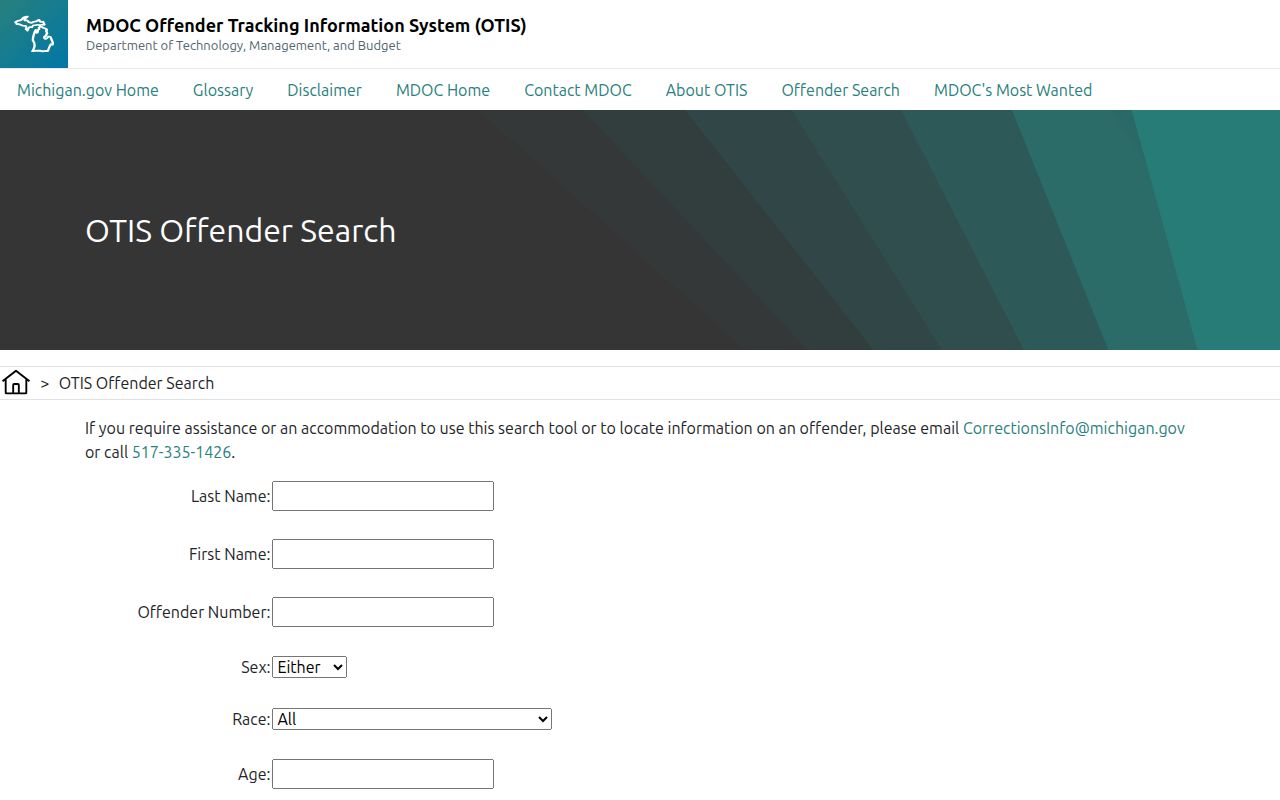
Choosing the right status view helps prevent an active-only search from hiding a relevant discharged record.
Michigan Prison Release Dates in Macomb County
Michigan commonly uses an indeterminate sentence with a judicial minimum and maximum. For covered truth-in-sentencing cases, official MDOC guidance says the prisoner serves the entire judicial minimum in a secure facility before parole consideration. The familiar claim that Michigan generally releases a prisoner after 85 percent is wrong. Serving the minimum creates eligibility for Board review, not an entitlement to parole.
The covered dates differ by offense category. Official guidance uses December 15, 1998 for covered assaultive crimes and December 15, 2000 for other covered crimes. MCL 791.233b supplies the secure-facility minimum rule, while MCL 791.234 governs Board jurisdiction and sentence relationships. The Board’s statutory finding under MCL 791.233 remains necessary.
A grant can carry prerequisites and can be stayed or changed before release. Even after parole status is conferred, another jurisdiction can hold the person. The verification hierarchy therefore gives more weight to `DATE PAROLED`, current status and location, and the agency record than to an eligibility date or an early Board action viewed alone.
Modern disciplinary time is often called “bad time.” It is considered during parole decisions rather than deducted as a credit from the truth-in-sentencing minimum. Legacy sentences can follow older good-time or disciplinary-credit rules. The MDOC glossary describes one eligible legacy period as five days per month plus up to two more days for especially good behavior, with a yearly cap and loss for major misconduct. That old formula must not be applied to a modern sentence without checking the offense date and type.
The MDOC truth-in-sentencing page explains the minimum-sentence rule used for covered Michigan cases.
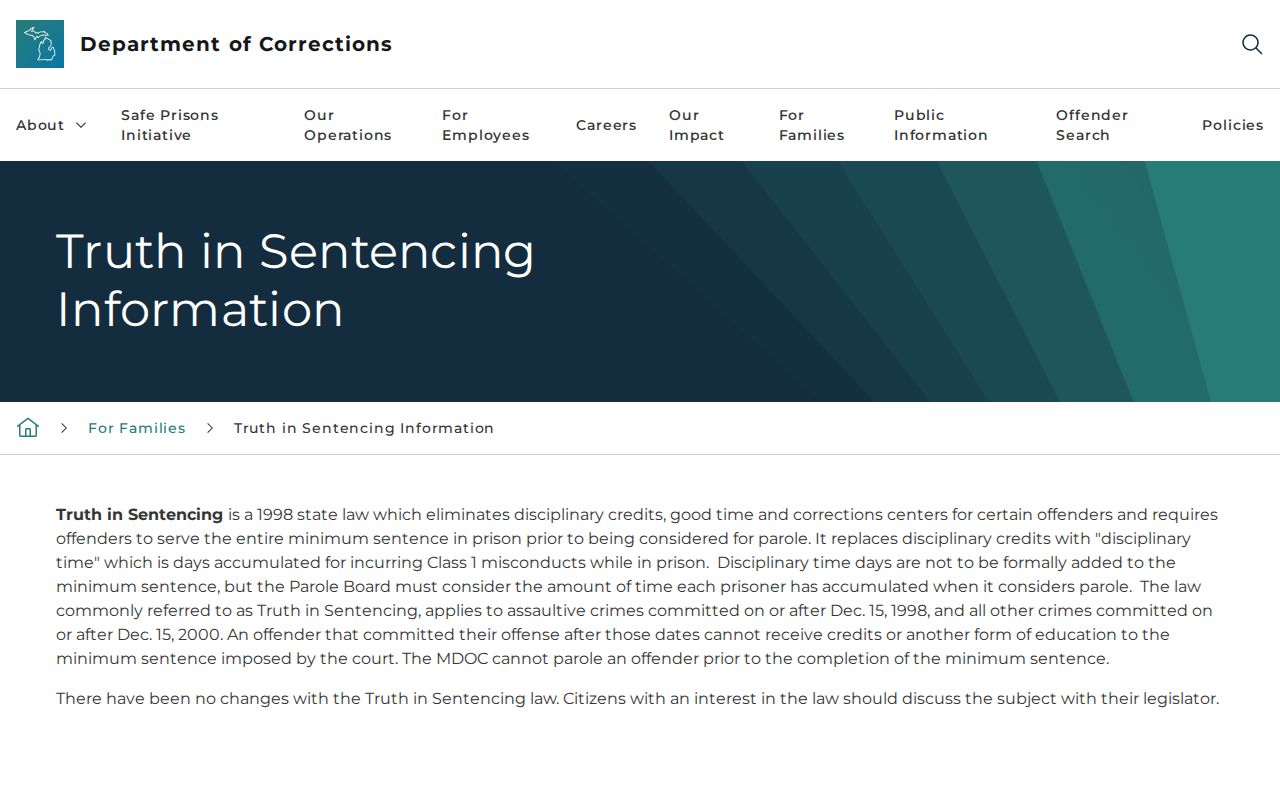
The state guidance supports reading the entire judicial minimum as an eligibility threshold rather than substituting an unsupported percentage.
Macomb County Jail Good-Time Calculation
County-jail good time is not an OTIS calculation. MCL 51.281 permits the sheriff to adopt jail conduct rules with circuit-judge approval. Under MCL 51.282, an eligible jail prisoner without rule violations receives one day of sentence reduction for every six days served. The sheriff has authority over forfeiture and restoration under the statute.
MCL 51.283 requires the rules and allowances to be posted and places a duty on the eligible prisoner to call the entitlement to the sheriff’s attention. The statute supplies a framework, not enough facts to calculate a named person’s date from the outside. Jail credit, the judgment, rule compliance, and the Sheriff’s own calculation must be reconciled.
No official Michigan statute was found that creates a general Friday release whenever a county-jail sentence ends on a Sunday or holiday. A requester should ask MCSO for the person-specific earliest release calculation. The Michigan Attorney General’s victim-rights guidance likewise directs jail-release calculations to the sheriff and state parole eligibility questions to MDOC.
Note: Never import an MDOC earliest-release field or a legacy prison credit formula into a Macomb County Jail sentence calculation.
Why Macomb County Release Dates Change
A date can change because a later record alters the controlling calculation, or because the date was never an exit promise. The effect depends on custody type. A corrected judgment can change a sentence field, while a detainer can leave a valid release from one agency followed at once by custody under another.
| Factor | Possible effect | Best source to check |
|---|---|---|
| Corrected Judgment of Sentence | Changes the legal sentence input | Sentencing court and MDOC |
| Concurrent or consecutive sentences | Changes which term controls eligibility or discharge | Court judgment and OTIS |
| Jail credit | Changes time credited toward the sentence | Court and holding agency |
| Legacy credit loss or restoration | Moves a date for an eligible older sentence | MDOC record |
| Detainer or hold | Ends one custody event but starts or continues another | Releasing and receiving agencies |
| Parole decision or conditions | Controls whether eligibility becomes parole and when prerequisites are met | Michigan Parole Board and OTIS |
A conflict may reflect different events instead of an error. A judge may sign a bond order, the jail may process release hours later, and another agency may then accept custody. A defensible date statement names the agency and event rather than claiming a person was free from every legal restraint.
The same rule applies to a maximum date. `MAXIMUM DISCHARGE DATE` is the displayed outer sentence endpoint for the controlling state sentence, not a prediction that the person will remain in prison until then. Parole can begin earlier after lawful eligibility and a grant. Conversely, a detainer can leave the person in another agency’s physical custody after Michigan prison custody ends.
Confirm a Macomb County Release Date
For an actual state-prison release, look for `DATE PAROLED`, current status, and the location field. If formal proof is needed, request a discharge certificate, date-paroled record, or other releasable material from MDOC. The public OTIS record generally remains available for three years after discharge from supervision, while MDOC directs certain past-prisoner records up to six years post-release to its records-retention channel.
For Macomb County Jail, request the booking-and-release transaction through the MCSO Records Office at `records.mcso@macombcountymi.gov`. Identify the person, booking or case number when known, and approximate dates. Ask for release date and time, release type, releasing authority, and transfer destination if maintained. Michigan FOIA ordinarily requires an initial grant, denial, partial response, or permitted extension decision within the statutory response clock, but that clock does not guarantee immediate production of a large record.
Macomb court access follows a different route because Michigan courts are not public bodies under Michigan FOIA. Macomb criminal matters can begin in one of ten district courts, while a felony bound over for trial proceeds in the 16th Judicial Circuit. District records can show arraignment, bond, misdemeanor disposition, and felony preliminary events. Circuit CourtView and Clerk document ordering can supply the later felony judgment or sentence. The signed order establishes legal authority, while the agency transaction supplies the actual custody event.
If a federal or immigration transfer is reported, switch systems. BOP’s locator can show a federal release date and no-current-location result for its custody, while ICE ODLS covers current and certain recent immigration custody. Neither result proves that no other authority holds or supervises the person. The source should always be named with the date.
A pending custody alert can supplement this work. The Macomb County VINE inmate check explains one-person searches and prospective event notifications. A VINE alert is a contemporaneous clue from the reporting agency, not a substitute for the court order or release transaction.